

Selecting the Right Home EV Charger in the UAE: 7kW vs. 11kW vs. 22kW Explained
A 22kW wallbox charger sounds significantly faster on paper than a 7kW alternative. However, real-world charging speed is always governed by the lowest-rated link in your setup: your car’s internal AC onboard converter, your home’s electrical infrastructure, and the physical installation itself.
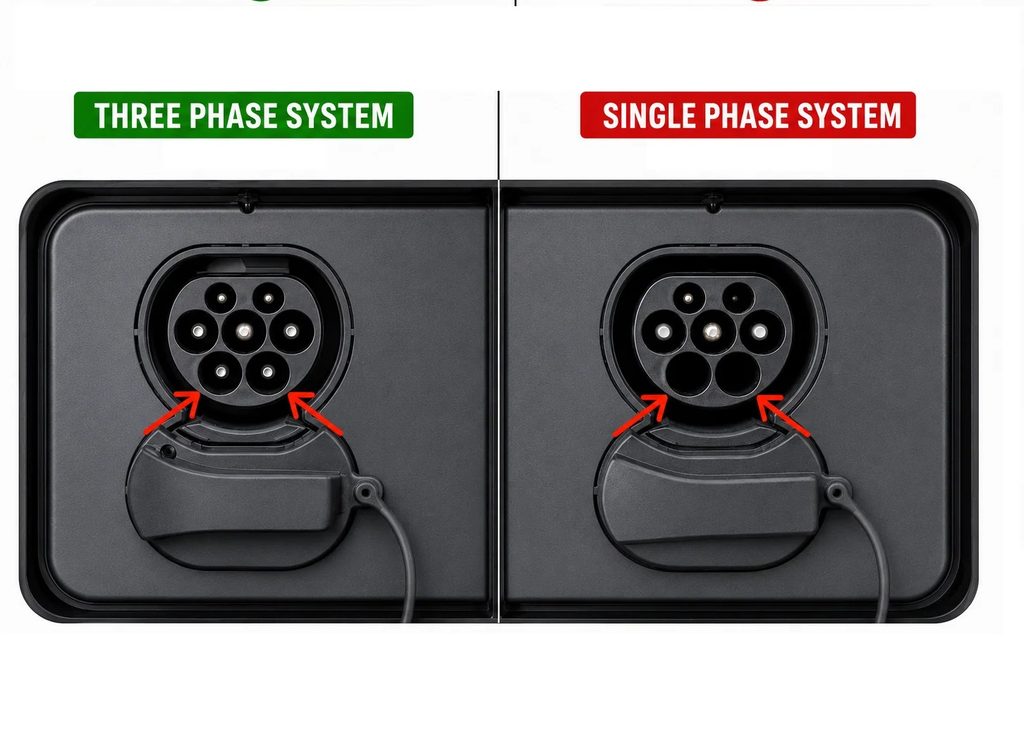
Opting for the highest wattage does not automatically mean faster charging. For a substantial portion of residential drivers across the UAE, a 7kW setup handles daily driving needs overnight with ease. The right decision depends strictly on the synergy between your vehicle’s specifications and your property’s electrical supply.
What Do 7kW, 11kW, and 22kW Actually Mean?
A charger’s power rating indicates the theoretical maximum energy it can feed into an electric vehicle per hour under optimal conditions. This output is calculated in kilowatts (kW).
While higher wattage allows greater electrical transfer, your charging rate will always bottleneck at the lowest-rated component between the grid, the wallbox, and the car.
| Charger Output | Standard Supply | Typical Application in the UAE |
| 7kW (7.4kW) | Single-Phase AC (230V / 32A) | Overnight villa charging, apartment bays, vehicles equipped with 7kW AC onboard limits |
| 11kW | Three-Phase AC (400V / 16A per phase) | Balanced, high-efficiency home charging for newer GCC/European-spec EVs with 11kW onboard support |
| 22kW | Three-Phase AC (400V / 32A per phase) | High-mileage commuters, multi-EV villas, and vehicles fitted with rare 22kW AC onboard converters |
Note: These ratings represent technical capabilities rather than a blanket guarantee for every residence. A licensed electrical engineering firm must inspect the distribution board, verify spare amperage, confirm cable routing, and evaluate protection parameters prior to mounting any unit.
7kW Home EV Chargers: The Dependable Overnight Workhorse
For many residential installations in Dubai, Abu Dhabi, and the Northern Emirates, a 7kW wallbox is the most practical and cost-efficient option. Operating across a standard single-phase 230V supply, it comfortably restores 35 to 45 km of driving range per charging hour.
Why Choose 7kW?
- Simpler Integration: Fits smoothly into single-phase residential supplies without demanding major main panel upgrades.
- Overnight Replenishment: Fully charges a standard 60–80 kWh battery pack in approximately 8 to 9 hours while you sleep.
- Ideal for Properties with Load Constraints: The go-to standard for apartment parking spaces, townhouses, or older villas where available electrical headroom on the distribution board is limited.
- Matches Popular Onboard Limits: Many EV models only feature a 6.6kW or 7.4kW single-phase AC onboard inverter; installing a larger charger will not yield any speed increase for these cars.
11kW Home EV Chargers: The Optimal Middle Ground
Stepping up to an 11kW charging station substantially cuts charging windows without imposing extreme electrical demands on a property. However, it requires a dedicated 400V three-phase electrical supply and an EV equipped with a three-phase onboard converter.
An 11kW charger can recharge a typical EV battery from empty to full in roughly 5 to 6 hours.
Key Considerations for 11kW:
- The Onboard Limit Remains Decisive: If your EV is capped internally at 7.4kW, connecting it to an 11kW charger will still yield a maximum delivery of 7.4kW. The car’s onboard charging electronics always dictate the ceiling.
- Three-Phase Requirement: Your property must have three-phase wiring available at or near the distribution panel.
- Balanced Demand: Because it draws 16A across three separate phases rather than a heavy 32A on a single line, it often integrates cleanly into balanced three-phase villa supplies.
- Best Suited For: Drivers with long daily commutes across emirates, individuals returning home late with depleted batteries, or multi-car families needing quick turnaround times.
22kW Home EV Chargers: Maximum Speed Where Supported
A 22kW wallbox represents the maximum capability of AC residential charging, supplying roughly 100 km of range per hour of charge time.
Nevertheless, 22kW installations must be approached with careful engineering oversight. Drawing 32A across three separate phases (a substantial 400V load), a 22kW wallbox requires substantial electrical supply capacity, heavy-gauge armored conductors, and dedicated upstream circuit breaker protection.
When Does 22kW Make Sense?
- Your Vehicle Actually Supports 22kW AC: Only select EV models (such as certain Porsche Taycan trims, Audi e-tron variants with dual onboard chargers, or specific European-spec vehicles) possess 22kW AC onboard converters. Most mass-market EVs cap AC intake at 11kW.
- Substantial Connected Load: Your villa or commercial property must possess ample spare transformer capacity and high-rated main distribution boards (MDBs).
- Demanding Turnarounds: Indispensable for high-mileage commercial fleets, shared residential charging points, or estate garages supporting multiple active electric vehicles back-to-back.
What Actually Determines Your EV’s Charging Speed?
To evaluate the right charger, avoid focusing solely on the total capacity of your battery. Instead, assess your actual daily kilowatt-hour consumption alongside three primary technical factors:
[Main Grid Supply & Amperage] ──> [Wallbox Output Rating] ──> [Vehicle Onboard AC Inverter]
                                  (The slowest link defines the speed)
- The Vehicle’s Onboard AC Converter:DC fast chargers bypass the vehicle’s internal converter, but every AC home charger feeds alternating current into the car’s onboard converter. If this internal unit accepts a maximum of 11kW, a 22kW wall charger will strictly deliver 11kW.
- Phase Availability & Panel Headroom:Single-phase supplies are fundamentally limited to 7kW–7.4kW. Utilizing 11kW or 22kW mandates a certified three-phase connection with verified spare capacity on the load schedule.
- Daily Kilowatt Consumption:Most UAE drivers travel between 40 km and 90 km per day, consuming 8 to 18 kWh of power. A 7kW wallbox restores this energy in under two to three hours, making a higher-tier charger an unnecessary expense unless multiple vehicles share the point.
Summary Checklist: Which Charger Should You Select?
- Select a 7kW Wallbox if: You have a single-phase residential supply, drive standard daily distances, want straightforward compliance with minimal panel adjustments, or your vehicle’s AC limit is 7.4kW.
- Select an 11kW Wallbox if: Your residence features a three-phase power supply, your vehicle supports 11kW AC charging, and you need a faster daily top-up for longer inter-emirate travel.
- Select a 22kW Wallbox if: Your EV is factory-equipped with a 22kW onboard converter, your electrical service entrance can comfortably sustain a 32A three-phase load, and you require the absolute fastest AC turnaround possible at home.
Engineering Your Home Setup with EVSHIELD
Selecting the wrong charger can result in unnecessary equipment costs, persistent breaker tripping, or underutilized hardware.
EVSHIELD delivers complete turnkey infrastructure solutions across Dubai, Abu Dhabi, and the Northern Emirates:
- Detailed Load Schedule Audits: On-site inspection of your distribution board to identify exact spare capacity before you purchase hardware.
- Full Regulatory Clearances: Complete drawing preparation and formal approvals through DEWA, TAQA (ADDC/AADC), and SEWA.
- Turnkey Execution: Professional cable containment, civil trenching, breaker sizing, and smart wallbox commissioning tailored to your vehicle.
Contact EVSHIELD today to schedule an electrical assessment and determine the ideal charging specification for your home.
7kW vs 11kW vs 22kW home EV charger UAE
best home EV charger wattage UAE
EV charger charging speed comparison UAE
single phase vs 3 phase EV charger UAE
fast home EV charging UAE
home EV charger power rating explained
7kW EV charger UAE / 7.4kW AC home wallbox
11kW EV charger installation UAE
22kW home EV charger Dubai
Zignova wallbox 7kW 11kW 22kW
EV onboard AC charger limit
onboard AC inverter 11kW vs 22kW
Type 2 AC home charger UAE
villa load schedule EV charger UAE
single phase 230V 32A EV charger
three phase 400V EV charger UAE
main distribution board capacity EV
MDB SMDB spare capacity load study
EV breaker sizing and RCD protection
armored cable for 22kW EV charger
DEWA EV charger load calculation
TAQA EV charger approval Abu Dhabi
ADDC AADC EV charger installation
SEWA approved EV charger installation
EVSHIELD turnkey EV charging UAE
certified EV charger installer UAE
EV charger installation Dubai
EV charger installation Abu Dhabi
EV charger installer Al Ain
villa EV charger installation Sharjah
home EV charger Northern Emirates (Ajman, RAK, UAQ, Fujairah)
villa EV charger Dubai Hills, Arabian Ranches, Damac Hills
