

EV Charger Installation in Abu Dhabi: What You Need to Know
Do you need permission to install an EV charger in Abu Dhabi?
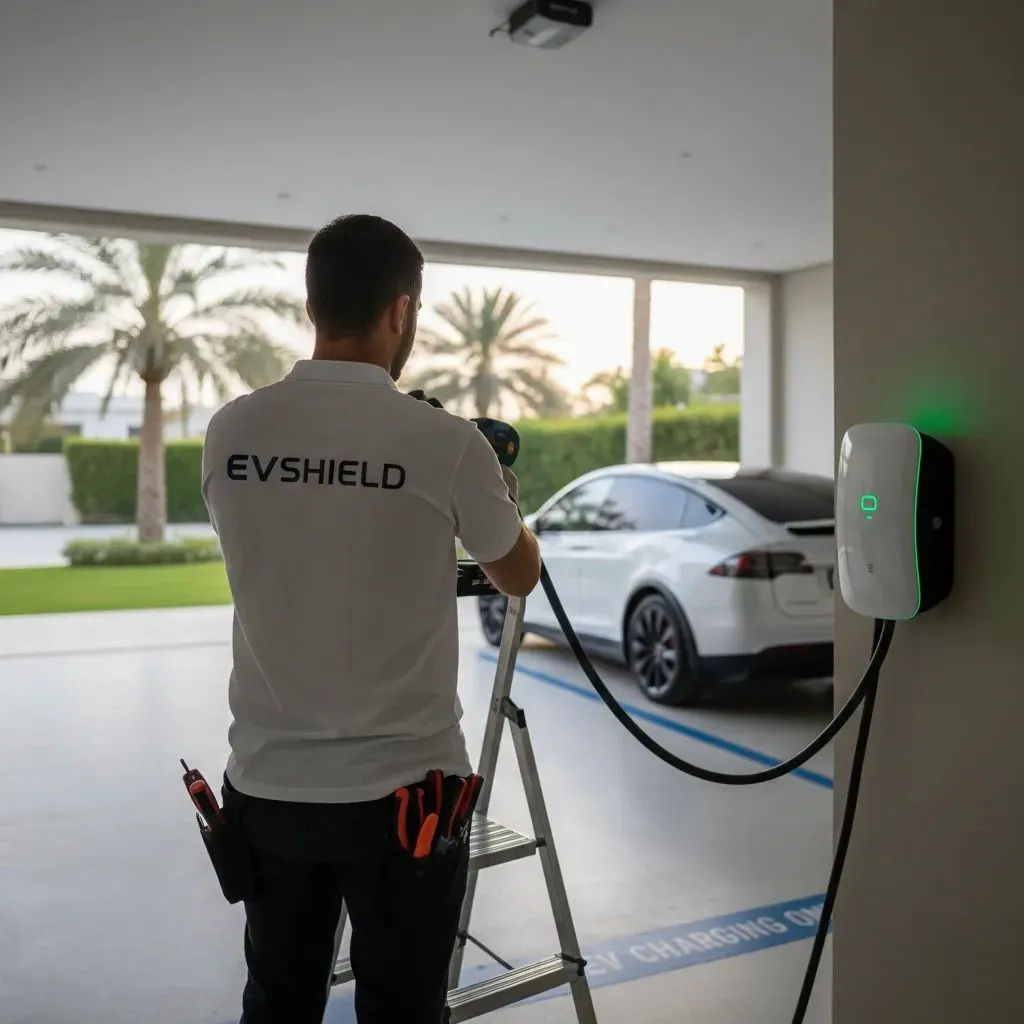
Yes, all residential and commercial electric vehicle charger installations in Abu Dhabi require regulatory approval. The primary governing utility is the Abu Dhabi Distribution Company (ADDC), operating under the Abu Dhabi Water and Electricity Authority (ADWEA) and the Department of Energy (DoE) framework. These approvals ensure grid reliability, protect local residential sub-stations from unmanaged peak loads, verify electrical safety, and guarantee fire-code compliance.
EV Shield manages the entire end-to-end permitting process on your behalf, handling technical Single-Line Diagrams (SLD), authority documentation, and inspection scheduling.
What are the approval rules for villas vs. apartments in Abu Dhabi?
Permit requirements vary depending on whether you own a private property or occupy a multi-tenant residential development:
- Private Villas: Straightforward approval process. Because the homeowner typically owns the dedicated parking area and the main distribution board (MDB), wiring upgrades and wallbox mounting proceed smoothly once ADDC approves the load application. EV Shield often completes villa installations in a single working day following utility clearance.
- Apartments & Shared Residential Buildings: Requires multi-party consent prior to utility submission. You must secure a formal No Objection Certificate (NOC) from the building developer, facility management company, or Owners Association (OA) confirming assigned deeded parking and cable-tray routing access.
- Commercial & Retail Properties: Complex permitting paths involving Civil Defense clearance, commercial-grade sub-metering, dynamic load-sharing architecture, and user-access management.
Essential Documents Required for ADDC Approval
- Emirates ID copy of the property owner or registered tenant.
- Property title deed (Mulkiya) or verified Tawtheeq tenancy contract.
- Manufacturer technical datasheet and EV charger specifications.
- Site layout plan indicating the parking bay and cable pathway.
- Existing electrical load schedule from the property’s distribution board.
- Building Management / Developer NOC (for apartments and tenant installations).
What are the core electrical installation requirements?
[Main Distribution Board (MDB)] ➔ [Dedicated 32A MCB/MCCB] ➔ [Class-A RCD/DC Leakage Protection] ➔ [Armored Fire-Rated XLPE Cable] ➔ [Weatherproof Rotary Isolator] ➔ [EV Wallbox]
A compliant Level 2 charging station requires dedicated engineering to handle continuous high-amperage draws:
- Load Capacity & Electrical Assessment: EV Shield conducts an on-site audit to measure existing household electrical consumption against utility feeder limits. This prevents breaker trips caused by high concurrent cooling loads during hot summer months.
- Circuit Protection & Cabling: Chargers must be installed on a dedicated circuit isolated with miniature circuit breakers (MCBs) and Class-A Residual Current Devices (RCD) with 6mA DC residual detection. Exterior installations require UV-stabilized, weather-rated conduits and high-impact rotary isolator switches.
- Thermal Management: Equipment placed in outdoor Abu Dhabi carports must carry an IP65 ingress rating and advanced heat dissipation to eliminate power throttling when ambient temperatures exceed 50°C.
7.4 kW vs. 22 kW EV chargers: Which should you choose?
| Metric / Specification | 7.4 kW AC Charger | 22 kW AC Charger |
| Electrical Supply | Single-Phase (230V, 32A) | Three-Phase (400V, 32A) |
| Typical Charge Time (0–100%) | ~7 to 11 Hours | ~3 to 7 Hours (Vehicle dependent) |
| Range Added Per Hour | ~35 to 45 km/hr | Up to 70 to 75 km/hr (11 kW max on Tesla) |
| Best Suited For | Townhouses, standard villas, overnight charging | Large villas, multi-EV garages, commercial fleets |
| Grid / Infrastructure Need | Minimal electrical adjustments required | Requires high-amperage 3-phase villa feeder |
Most standard UAE homes run on single-phase connections suitable for 7.4 kW units. Larger detached villas and newer residential developments feature three-phase supplies capable of supporting 11 kW to 22 kW wallboxes.
Note: Modern European and GCC-spec electric cars (such as Tesla Model 3 and Model Y) feature onboard AC inverters limited to 11 kW, making a three-phase setup ideal to achieve full charging performance.
What is included in EV Shield’s turnkey Abu Dhabi installation service?
EV Shield manages the entire charging setup from inception to commissioning:
- On-Site Survey & Load Check: Detailed inspection of your panel board, cable run paths, and available amperage headroom.
- ADDC / Developer Approvals: Drafting technical SLDs, submitting permit files, and securing utility clearances.
- Hardware Supply: Provision of premium climate-hardened Type 2 or native GB/T smart chargers.
- Wiring, Conduit & Mounting: Installation using armored, fire-rated XLPE cabling, UV-protected trunking, and rotary isolators.
- Testing, App Pairing & Handover: Conducting earth loop impedance checks, testing DC leakage, pairing smartphone controls, and verifying live vehicle charging.
- Warranty & Aftercare: Full installation warranty backed by UAE-based technical support and emergency field service.
What is the project timeline for an EV charger installation in Abu Dhabi?
[Day 1–2: Site Survey & Consultation]
[Day 3–7: Documentation & ADDC Submission]
[Day 7–12: Utility Approval & Scheduling]
[Day 13–14: Installation, Testing & Handover]
- Day 1–2 (Consultation & Site Survey): Technicians evaluate property distribution boards, determine cable distances, and establish optimal charger placement.
- Day 3–7 (Permit Documentation): Preparation of Single-Line Diagrams and submission to ADDC or the relevant property management body.
- Day 7–12 (Approvals & Scheduling): Utility verification and scheduling an installation window suited to your availability.
- Day 13–14 (Installation, Testing & Handover): Physical mounting, connection to dedicated breakers, firmware configuration, and live EV charging demonstration.
Standard residential turnkey setups are typically delivered within 7 to 14 working days, depending on authority processing intervals.
How much does EV charger installation cost in Abu Dhabi?
Installation costs vary based on site-specific electrical infrastructure:
- Charger Power Rating: 7.4 kW single-phase hardware vs. 22 kW three-phase commercial units.
- Cable Routing Distance: The total run of armored cabling required between your electrical distribution panel and the parking bay.
- Civil Works: Requirements for trenching, asphalt cutting, protective bollards, or custom mounting pedestals.
- Electrical Panel Upgrades: Installing auxiliary sub-distribution boards or dynamic load balancing hardware to manage summer cooling spikes.
EV Shield conducts a physical or virtual site assessment to provide a fixed, transparent quotation with no hidden charges prior to commencing work.
Future-proofing your home electrical infrastructure
When installing an EV wallbox, forward-thinking homeowners prepare for evolving charging demands:
- Oversized Cable Conduits: Running larger conduits during initial installation makes adding a second charging unit easier without future wall cutting or trenching.
- Dynamic Load Balancing: Automatically throttles charging speeds when central air conditioning units activate, preventing main circuit breaker trips.
- Solar PV System Integration: Integrating your wallbox with rooftop solar arrays enables daylight charging directly from green residential solar generation.
Frequently Asked Questions (FAQ)
Will installing a home EV charger increase my monthly ADDC electricity bill?
Charging at home adds consumption based on your vehicle’s battery capacity and weekly mileage. However, charging overnight at residential utility rates remains substantially cheaper than relying on commercial DC fast chargers or refueling a conventional petrol vehicle.
Can EV Shield install the charger supplied with my new electric car?
Yes. Technicians install and commission official dealership-supplied chargers—including wall units from Porsche, BMW, Mercedes-Benz, Audi, and BYD—ensuring complete compliance with ADDC electrical codes.
What happens if my smart EV charger loses its Wi-Fi connection?
Your EV charger will continue to deliver safe charging at its configured amperage even without an active internet connection. An internet connection is only necessary for real-time app telemetry, firmware updates, and scheduled off-peak charging automations.
Book Your Abu Dhabi EV Charger Installation
- Service Provider: EV Shield UAE
- Phone / WhatsApp: +971 50 832 8392
- Email: projects@evshield.ae
- Coverage: Abu Dhabi Island, Yas Island, Saadiyat, Al Reem, Khalifa City, Mohammed Bin Zayed City, and Al Ain
EV charger installation in Abu Dhabi what you need to know, ADDC approved EV charger installation, EV Shield Abu Dhabi, home EV charger installation cost Abu Dhabi, 7.4kW vs 22kW EV charger UAE, villa EV charging setup Abu Dhabi, apartment EV charger approval ADDC.
